As a part of my profession, I work on artificial intelligence and deep learning. Artificial intelligence has good connection with Natural Language Processing, which is also called NLP but this post is about connection of Neuro Lingustic Programming and AI. Recently I was learning about methods applied for object recognition. A method used by neural networks is very interesting. Let me first explain the method in short. If you know NLP then you will certainly able to correlate it with NLP. A neural net generally has pictures of various objects and it learns from those pictures. For example, suppose we want to teach a neural network to identify a car. Then we are supposed to pass many pictures of various cars. Now let us see how neural net understands a car. A neural net down samples a picture to eliminate all the details to understands a shape of an object. Addi...
Saptavargaja Bala means the strength of the seven-fold division. For calculating the Saptavargaja bala 1. The relative strength of a planet either being in the sign of the friend or enemy is first ascertained. Moreover the temporary friendship or enmity is also ascertained. The combination of temporary and permanent relationship gives us more comprehensive combined relationship. This relationship is applied to sapatvargas and then the strength is ascertained. 2. Out of shodahsavargas Rasi, Hora, Drekkana, Saptamsa, Navamsa, Dwadashamsa and Trimsamsa together create saptavarga. For ready reference we are giving the table of Permanent Friendship and Temporary Friendship between the planets. Permanent Relationship (Naisargika Maitri) Planet Naisargika Mitra (Friend) Naisargika Shatru (Enemy) Sama (Neutral) Sun Moon Mar Jup Ven Sat Mer Moon Sun Mer None Mar Jup Ven Sat Mars Sun Moon Jup ...
Recently someone asked me about the scientific meaning of Shree Saraswathi Yanthram and I thought many of you may have same question. Many Hindus have been drawing and praying Shree Saraswathi Yanthram or Shree Saraswathi sign since childhood. Many of you may know that Shree Saraswathi is a goddess of 14 Vidya or sources of knowledge and 64 Kala or art forms. Therefore, she is also a goddess of creation and creativity. On another note Shakthi is represented by a triangle in Vedic culture. The real meaning of word Shakthi is skill. You may wonder why a skill is represented by a triangle. A skill is represented by a triangle because a skill requires perfect coordination between Mind, Body & Intellect. The 3 sides of a triangle represent Mind, Body & Intellect. Let’s learn about Shree Saraswathi Yanthram in this context. Below is a picture of Shree Saraswathi Yanthram. As you observe the pictur...
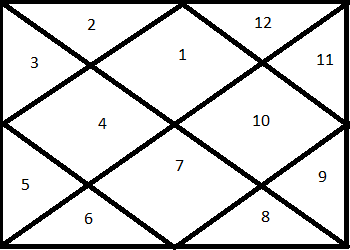
In the course of explaining details of astrology it is possible that I may explain few horoscopes and it is useful to understand the basics of reading horoscope. Today we will learn how to read horoscope drawn in north Indian way. Once you learn this, south Indian way is not very difficult. A horoscope consists of houses and signs. You may know that there are total 12 signs and there are 12 houses as well. Every planet is posited in one of the 12 signs sign and in one of the 12 houses. The most important sign is ascending sign or an ascendant. This is also called Lagna in Indian astrology. In north Indian style, houses in a horoscope are shown at fixed location. Below diagram shows houses in a north Indian horoscope. So 1 means first house, 2 means second house and so on… In your horoscope you may see ...
In this post we are going to cover the calculation of sunrise and sunset. Sunrise takes place when the sun appears on the eastern horizon. The time for sunrise varies according to the location. For instance, the time for sunrise at a place located at 15 deg. North and 90 deg. East will be different from a place located at 45 deg. north and 90 deg. East. The formula for sunrise is: 1. tan (sun's declination) * tan( latitudes of place ) let us call this as X 2. Now find the sin inverse of X. The product is in degrees minutes. If the sun is in Uttarayana and the location is in northern hemisphere then. The product calculated above should be added in 90 deg. If however the birth is in Dakshinayana and the location is in northern hemisphere then the above product should be deducted from 90. The reverse holds true when the birth is in southern hemisphere. The product d...




Comments
Post a Comment